This article explains hydrocolloid pimple patches as medical-grade wound dressings that absorb pus and oil while maintaining a moist healing environment. It details when they work best on open whiteheads versus when they fail on cystic acne and blackheads, what separates good patches by thickness and adhesion, how to apply them correctly, common mistakes, and how to choose plain versus active formulas for sensitive skin.
- Hydrocolloid pimple patches absorb pus and oil while sealing the blemish from bacteria and picking, creating a moist environment that supports healing.
- Patches work best on open whiteheads and oozing pustules and are not effective for blackheads or deep cystic acne with no surface fluid.
- Good patches are judged by thickness, adhesive hold, absorption signal that turns white, and size options rather than packaging claims.
- Apply to clean dry skin, press edges 10 to 15 seconds, wear six to eight hours, and replace when the center turns white and puffy.
- Plain hydrocolloid is less likely to irritate sensitive skin, while salicylic acid or tea tree infused versions may cause dryness and irritation for reactive types.
What Hydrocolloid Pimple Patches Are and How They Work
Hydrocolloid pimple patches are medical-grade wound dressings, small, slightly gummy stickers made from a gel-forming polymer that sits directly on a pimple to absorb pus, oil and fluid, seal out bacteria and picking, and support faster healing with less scarring risk. They work by moisture, not by drying the blemish out.
Dermatology adapted the technology from hydrocolloid wound dressings, which doctors first used for general wound care like leg ulcers and pressure sores as they moved toward moisture-based healing techniques, long before the material was shaped into small dots sized for acne.
Cleveland Clinic dermatologists describe them as wound-healing dressings for a very specific lesion. The inner layer can absorb fluids like pus and oil to help drain an opened zit, while the outer film covers the blemish to protect against infection and further picking. At the same time, the gel maintains a moist environment that helps skin cells move and repair, rather than letting the spot dry out and crust. That dual action (drawing fluid into the patch while keeping the wound sealed and moist) is why patches work differently from spot treatments that sit on top of skin. That mechanism explains why patches excel on some blemishes and do almost nothing for others.
When Hydrocolloid Patches Work Best (and When They Don't)
Should you put a hydrocolloid patch on a deep, painful bump? No: hydrocolloid pimple patches work best on surface-level, open or oozing whiteheads and pustules, not on blind cystic acne or blackheads where there is no exposed fluid to lift.
Knowing which blemishes respond tells you nothing about which patch to actually buy.
Judge readiness by what you can see. A visible white or yellow head, a spot that just opened after picking, or a pustule with pus at the tip has fluid at the surface a patch can collect. A firm, tender nodule with no head, a deep ache under the skin, or a dark black dot from oxidized oil and dead cells offers little surface fluid, so a patch has little to act on.
Dermatology guidance aligns with that visual check. Cleveland Clinic dermatologists note patches are most effective over open-and-oozing zits and are less useful for closed pimples. WebMD's medical review similarly states patches can't treat blackheads and aren't effective for cystic acne because the material is trapped too far beneath the surface or lacks fluid.
One controlled comparison often cited in current answers helps illustrate the limit. Researchers compared hydrocolloid patches with surgical tape in people with mild to moderate acne, changing the dressing on a regular schedule over about a week. Both groups had less severe acne by the end, but the hydrocolloid group showed greater improvements over the course of the study, including better control of redness, oiliness and dark pigmentation.
Hydrocolloid patches are best for surface-level, oozing blemishes, not deep cystic acne or blackheads.
What Separates a Good Patch from a Mediocre One
A good hydrocolloid pimple patch separates itself from a mediocre one by measured thickness, adhesive engineering, and absorption capacity, not just packaging. The common misconception is that any circle labeled "100% hydrocolloid" works the same, so shoppers ignore the specs that actually determine whether a patch stays invisible under makeup and pulls fluid.
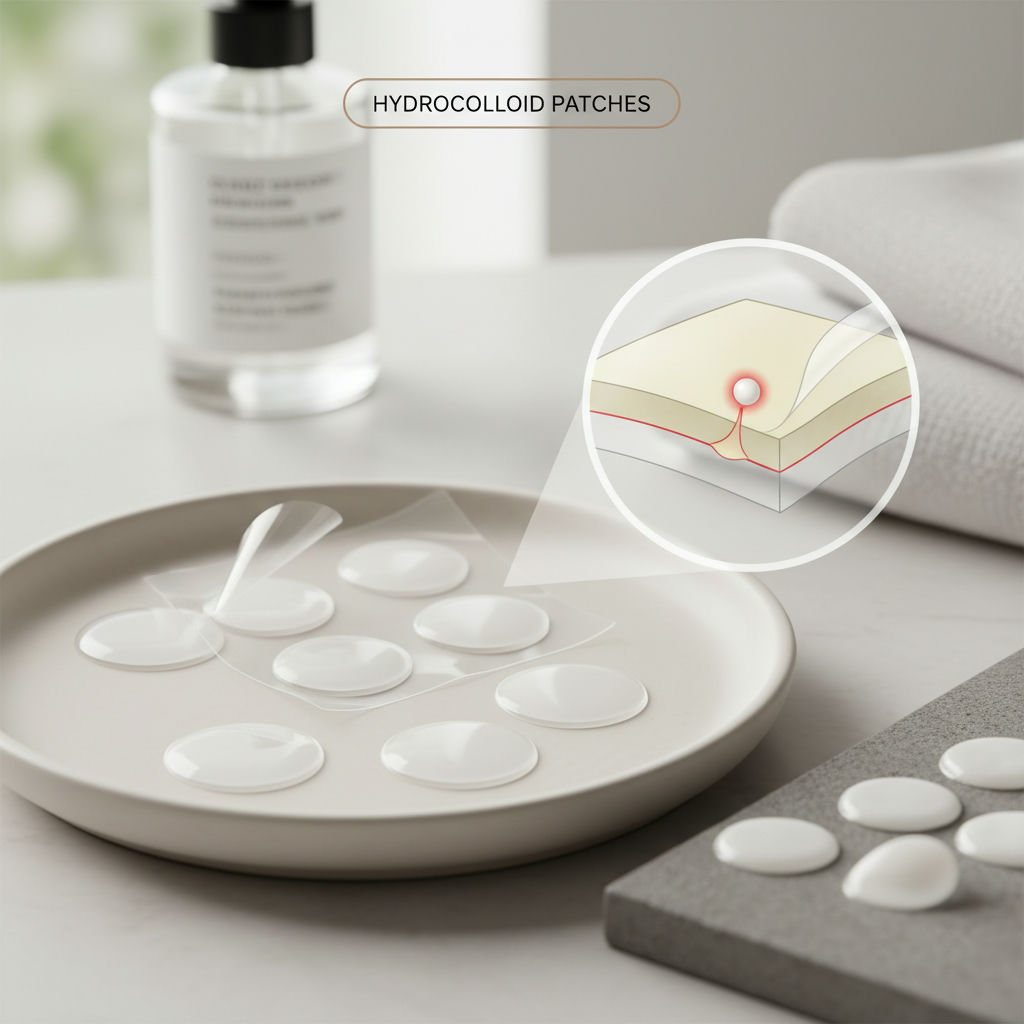
Thickness is the first filter. Thicker patches hold more fluid and work faster, making them suitable for shorter, more intensive wear, while thinner patches sit nearly flat and blend under sunscreen or makeup but typically need longer on the skin for full extraction. Leaving a saturated patch on well past its useful window does not improve results.
| Criterion | What to Look For | Why It Matters |
|---|---|---|
| Thickness / Invisibility | — | Thin is discreet; thick absorbs faster but shows |
| Adhesive Hold Duration | Tapered edges, matte medical-grade adhesive | Resists curling; holds all night or all day |
| Absorption Capacity | Turns white when saturated; thick holds more | Signals when to remove and replace |
| Size Options | Multiple diameters (10mm, 12mm) or multi-size packs | Better seal for small vs large inflamed spots |
| Infused Actives | Plain vs salicylic acid, tea tree, centella, niacinamide | Actives may help but irritate sensitive skin |
(A few rows are drawn from limited, sourced examples rather than a full market survey; treat them as illustrative, not exhaustive.)
Adhesive hold is the failure point most users notice. Tapered edges that thin at the perimeter conform to the nose, chin, and jawline better than a straight-cut edge, and medical-grade adhesive with a matte finish resists edge curling from oil and nighttime movement.
Absorption signal matters too. A working patch turns white and opaque as it draws fluid. That color change tells you to remove it, not to keep it on for extra time.
Size options prevent waste and lifting. Multi-size packs with smaller dots for tiny spots and larger covers for inflamed areas seal better than forcing a one-size dot over a bigger lesion. High-count value packs suit frequent users, while smaller counts stay fresher.
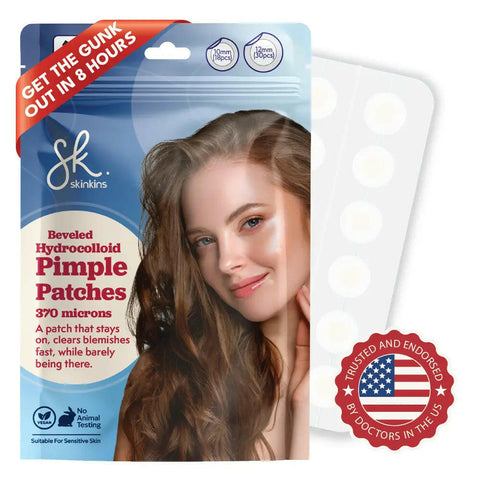
Infused actives are a trade-off for sensitive skin. Plain hydrocolloid protects without added irritants. Patches with salicylic acid, tea tree oil, and centella asiatica (including microdart formats designed to deliver actives deeper into the blemish) may help unclog and soothe, but they can sting reactive skin. Niacinamide can aid redness, yet pure hydrocolloid remains safest for hypersensitivity. SKIN KINS is positioned as an ultra-thin, plant-based, hypoallergenic option designed for all-day invisible wear on sensitive skin. Picking the right patch is only the first step; applying it correctly determines whether it delivers.
How to Apply Hydrocolloid Patches for Best Results
Apply hydrocolloid patches to completely clean, dry skin, and plan to leave them on long enough for the gel to fully absorb the fluid underneath, typically overnight or across a several-hour stretch of the day. Even with correct technique, patches sometimes seem to underperform; that usually comes down to application details, not the patch itself.
Start with bare skin. Wash the area with a gentle cleanser, rinse thoroughly, and pat dry, with no moisturizer, oil, or treatments underneath. Dermatology references advise you should clean the open pimple and dry your skin before placing the patch, because any slip layer prevents adhesion and blocks absorption.
Then size and secure:
- Choose a patch that fully covers the blemish plus a small border. A patch slightly larger than the spot seals better than one that just dots the center.
- Peel with clean, dry hands. Avoid touching the hydrocolloid center.
- Center it over the blemish and press for 10 to 15 seconds, focusing on the edges to lock the seal. That edge press prevents lifting when you move or sleep.
Timing: most dermatology guides recommend leaving the patch on well into the several-hours range, often as an overnight application. If the patch turns opaque white and puffy earlier, you can change it. Do not leave a saturated patch on indefinitely.
Removal matters. Peel slowly from one edge, pulling parallel to skin rather than straight up. If it resists, dampen the edge with warm water for a few seconds. Cleanse gently afterward and let the skin breathe before reapplying.
For daytime wear, apply before makeup and wait a minute for adhesion. Dab foundation or concealer around the patch edge, never under it. For overnight wear, apply as the last step and keep hair or pillow friction off the area to hold the seal.
Common Mistakes That Make Patches Fail
Hydrocolloid pimple patches fail most often when you apply them to a blemish that has no fluid to give, leave a saturated patch on too long, or stick them to oily, damp skin that breaks the seal.
You peel a patch off in the morning expecting that cloudy white center and see nothing. That does not automatically mean the patch is defective. Dermatologists note the white, swollen look is the signal fluid was drawn, so no change on a deep, closed bump usually means there was nothing for the hydrocolloid to absorb.
The five errors that waste patches:
- Targeting a dry or deep lesion. If there is no opening or pus pocket, the hydrocolloid has nothing to draw.
- Leaving a full patch on for extra hours. Dermatologists advise against extending wear far past the standard window, noting it offers no added benefit and can irritate sensitive or acne-prone skin.
- Sizing too small. A patch that does not fully cover the lesion plus a small margin lifts early and leaks.
- Skipping skin prep. Applying over moisturizer, oil, or makeup prevents adhesion. A clean, dry surface is needed for a proper seal.
- Misreading an allergy as acne. Most people tolerate pure hydrocolloid, but an allergy to the material, including adhesives, is not uncommon, so persistent redness, burning, itching, or a rash in the shape of the patch after removal is a stop signal, not a healing sign.
If you see spreading redness, severe pain, or repeated cystic swelling that never yields fluid, that is not a patch failure. A patch simply cannot fix that kind of lesion. See a dermatologist for persistent, painful, or infected lesions instead.
Choosing the Right Patch for Your Skin and Situation
Choosing the right hydrocolloid pimple patch is a tradeoff between gentleness and extra treatment power. For sensitive skin and daily wear, plain hydrocolloid patches that are thin and stay put outperform heavily medicated options that can drive irritation.
Look Clearer, Faster - Our blemish patches for face work to visibly shrink pimples. A great hydrocolloid patch for faster recovery without irritation.
If your skin reacts easily, start with plain hydrocolloid: these pads don't contain active ingredients or harsh chemicals, making them less likely to irritate sensitive skin. Save salicylic acid, tea tree or other infused actives for occasional, more congested spots, knowing that salicylic acid patches may not be ideal for very sensitive or dry skin.
Match wear time to lifestyle. For daytime or under makeup, you want the thinnest, most invisible edge that holds all day. For overnight, you can tolerate a slightly thicker patch with stronger adhesion and more absorption. If you get one or two pimples at a time, single-size dots are enough; if you break out in clusters, multi-size sheets reduce waste and let you size the patch to the blemish.
For most people, especially sensitive-skin types, a thin, plain or gently-infused hydrocolloid worn appropriately beats picking or harsh spot treatments, and irritation usually traces to added actives or misuse, not the hydrocolloid material itself. SKIN KINS' ultra-thin, plant-based, hypoallergenic patches are built for that invisible, makeup-compatible use case.
Verdict: choose the thinnest, plainest hydrocolloid that stays put for your wear-time. Added actives are a bonus, not a requirement.
Quick shopping check: plain hydrocolloid base? Edge thin enough to disappear? Stays on for your planned wear? Actives only if your skin tolerates them?
Sources
- What Are Hydrocolloid Patches for Pimples?
- Can Pimple Patches Make a Zit Go Away?
- 5 Best Hydrocolloid Patches | Absorbs Gunk in 6 Hours Flat
- The Best Pimple Patches
- Patch Routine: Apply Acne Patches Before or After Moisturizer?
- 5 Pimple Patch Mistakes to Avoid
- Using Pimple Patches? Don’t Make The Same Mistake That I Did
- Understanding Pimple Patches: A Comprehensive Guide
- Hydrocolloid vs. Salicylic Acid: What's Actually in Your Pimple Patch?
Frequently Asked Questions
Can I use hydrocolloid patches on blackheads or deep, painful cystic acne?
No. WebMD notes they are not effective for cystic acne and can't treat blackheads because there is no exposed fluid at the surface for the gel to draw. They work when pus or oil is already at the head or oozing.
My patch never turned white. Does that mean it failed?
A white, opaque, slightly puffy center is the signal that fluid was drawn into the patch. If the blemish was firm, closed, or had no head, there was simply nothing for the hydrocolloid to collect, so no color change is normal.
How long should I leave a patch on, and is longer better?
Most guides recommend six to eight hours per application, often overnight, while thick patches of 400+ microns can saturate in three to six hours. Wearing beyond eight hours doesn't necessarily make it more effective and can lead to irritation or clogged pores.
Should I put moisturizer, oil, or makeup under the patch?
No. You should clean the open pimple and dry your skin with no moisturizer, oil, or makeup underneath, because any slip layer breaks the seal. If you wear makeup, apply the patch first and dab product around the edge, not under it.
Are patches with salicylic acid, tea tree oil, or microdarts better than plain hydrocolloid?
Plain hydrocolloid is less likely to irritate sensitive skin and protects without added chemicals. Infused options with salicylic acid, tea tree oil, and Centella asiatica may help some spots, but salicylic acid patches may not be ideal for very sensitive or dry skin and can cause dryness and irritation.
Can hydrocolloid patches cause an allergic reaction?
Yes. Allergy to the material, including adhesives, is not uncommon. If you notice persistent redness, burning, itching, or a rash in the exact shape of the patch after removal, stop use and let the skin calm.
Can I cut a large patch to size or reuse a patch?
Cutting can damage the tapered edge that keeps the patch sealed and reduce absorption. It is better to use multi-size packs with options like 10mm and 12mm to match the blemish and always apply a fresh patch.
Do I need to pop or squeeze the pimple before applying a patch?
You do not need to squeeze hard. Patches are most effective when placed over open-and-oozing zits and they also protect against further picking. Harsh squeezing raises infection risk, while gentle cleansing is enough.