This guide breaks down the RID Super Max 5-in-1 Complete Lice Treatment Kit, detailing its three components and five claimed functions. It explains how the suffocation-based formula kills regular and pesticide-resistant super lice and eggs, unlike permethrin. It covers step-by-step application, combing, retreatment timing, safety limits for young children, and CDC-based laundry and environmental cleanup to prevent reinfestation.
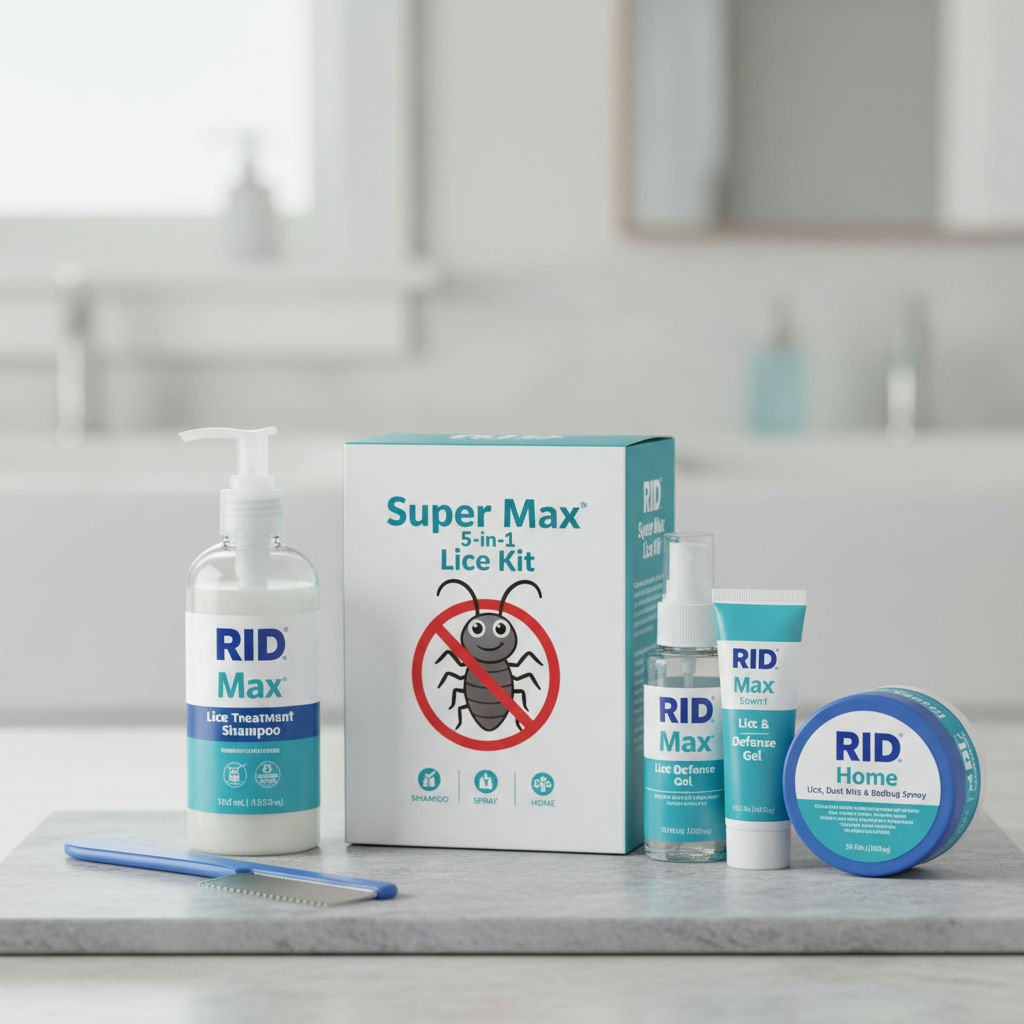
- RID Super Max 5-in-1 Complete Lice Treatment Kit contains a 3.4 FL OZ lice treatment solution, a fine-tooth lice comb, and a 6.8 FL OZ daily defense shampoo and conditioner.
- The 5-in-1 label means the system claims to kill lice fast, kill super lice, kill and remove eggs, provide immediate defense, and provide 24/7 defense with daily use.
- Unlike permethrin 1% and pyrethrins, RID Super Max kills 100% via lice-suffocating action, so knockdown-resistance mutations that reduce pesticide efficacy do not block it.
- Correct use is apply treatment, lather and wash with lukewarm water, comb damp hair from the base of the shaft close to the scalp, then switch to daily defense shampoo.
- Recheck at 7 to 10 days for hatching, monitor for 2 to 3 weeks, and see a provider if live lice remain 8 to 12 hours after treatment or child is under labeled age.
What's in the RID Super Max 5-in-1 Kit and What It Actually Treats
The RID Super Max 5-in-1 Complete Lice Treatment Kit is a pesticide-free over-the-counter system built around three components (a treatment solution, a nit comb, and a daily defense shampoo) designed to kill regular head lice, pesticide-resistant "super lice," and their eggs (nits) while adding defense against reinfestation. The "5-in-1" claim on the box refers to five advertised functions: 1) kills lice fast, 2) kills hard-to-kill super lice, 3) kills and removes eggs (nits), 4) provides immediate lice defense, and 5) provides 24/7 lice defense for return to school or camp.
The WHAT'S INSIDE section lists three physical components: RID SUPER MAX Lice Treatment Solution in a 3.4 FL OZ bottle, a RID Lice Comb for removing dead lice and nits after treatment, and RID Daily Defense Shampoo & Conditioner in a 6.8 FL OZ bottle intended for daily use after treatment.
The kit is positioned as a complete treat-and-defend system rather than a single bottle of shampoo. It kills super lice and eggs with the treatment solution, then aims to reduce the risk of spread or return exposure when kids go back to shared environments like school or camp. That 5-in-1 label raises an obvious question: what actually kills the lice, and how is it different from older treatments?
Suffocation-Based Formula vs. Pesticide Treatments: Why 'Super Lice' Resistance Matters
The RID Super Max formula kills lice by suffocation, working via its lice-suffocating action rather than by poisoning the louse nervous system the way permethrin and pyrethrins do. When you reach for a second box after a permethrin rinse failed to stop the scratching, that difference in mechanism is the deciding factor.
Traditional over-the-counter options use neurotoxic pyrethroids. Pyrethrins are natural extracts from the chrysanthemum flower and permethrin is a synthetic version; both kill live lice by disrupting sodium channels in the insect nervous system. The CDC notes that efficacy is slipping because lice have adapted: lice have developed some resistance to 1% permethrin, and pyrethrin efficacy may be reduced because of development of resistance.
That adaptation is what people mean by "super lice." Lice populations carrying knockdown-resistance (kdr) mutations in the sodium-channel gene survive doses that once killed them. They are not stronger, larger, or disease-carrying; they simply carry a genetic tweak that makes neurotoxic treatments less reliable, which is why treatment failure after correctly applied permethrin now signals resistance rather than user error.
A suffocation-based product sidesteps that chemistry entirely. RID Super Max claims its shampoo kills 2X faster than the leading pesticide hair treatment because it coats and blocks the lice respiratory spiracles and disrupts the waxy cuticle, causing death by physical asphyxiation and dehydration. Since it does not rely on the sodium-channel target, kdr mutations do not confer protection against it.
| Criterion | Suffocation-based (e.g., RID Super Max) | Traditional pesticide (permethrin/pyrethrin) |
|---|---|---|
| Mode of action | Physical suffocation — 100% claimed, coats spiracles | Neurotoxic — disrupts louse sodium channels |
| Impact of kdr resistance mutations | Unaffected — no sodium-channel target | Reduced efficacy — CDC notes resistance |
| Effect on eggs (nits) | Claims to kill super lice and eggs | Kills live lice only, not unhatched eggs |
| Retreatment guidance | Per product label (see application section) | 9-10 days after first treatment |
Suffocation-based agents target lice physically, not neurologically, which is why resistance to permethrin and pyrethrins does not make lice immune to this mechanism.
How to Apply the Kit Step-by-Step: Timing, Re-Treatment, and Nit-Combing
Executing the treatment correctly matters as much as the chemistry behind it: missed coverage or rushed combing is where most treatments fail. The kit follows a four-step apply, wash, comb, and daily-defend routine, with a follow-up lice check at 7-10 days to determine if retreatment is needed.
Step-by-step per manufacturer label:
- Apply RID SUPER MAX Lice Treatment Solution. The Treat & Defend kit includes a 3.4 FL OZ treatment bottle. Work the solution through the entire scalp and hair to ensure full saturation from roots to ends. Complete instructions are provided in English and Spanish on the kit.
- Lather and wash. The label directs you to lather and wash with lukewarm water. Rinse thoroughly and towel dry.
- Comb with the included RID Lice Comb to remove dead lice and nits. Use the fine-toothed comb while hair is still damp and detangled. Divide hair into small sections, then comb each section starting at the base of the hair shaft, close to the scalp and pulling through to the ends. Wipe the comb on a white paper towel after each pass to see what you removed. Continue section by section around the entire head, re-combing areas where nits cling.
- Defend after treatment. Switch to the RID Daily Defense Shampoo & Conditioner which provides 24/7 defense with daily use. The 6.8 FL OZ bottle in the kit is designed for daily use after the treatment phase, both for the treated child returning to school or camp and for other family members to help reduce household spread.
Re-treatment window and follow-up checks:
Check hair after 7-10 days and repeat treatment if any live lice or eggs are present, per RID FAQ guidance; this window corresponds to when unhatched nits complete their hatching cycle, not simply a fixed calendar rule. The same FAQ points to CDC guidance to keep checking afterward to confirm all lice and nits are gone. If you still see live, moving lice at the 7-10-day check, that is the point to reapply per label, not earlier.
Always read and follow the kit's label directions for exact leave-on time and amount, and do not combine with other head-lice medicines unless directed. Getting the steps right matters even more for households with young children or family members with sensitivities, which raises the safety question.
Safety Profile: Age Limits, Sensitivities, and When to See a Doctor Instead
The CDC tells families to consult a healthcare provider before treating young children for head lice, and retail cartons that reproduce the RID Super Max 5-in-1 label list the intended use as adults and children from 1 year of age and older, a labeled minimum that excludes infants under 12 months. Safety boundaries like this determine whether the kit is even the right choice for a given household, separate from whether the application steps were followed correctly.
Pediatric guidance reinforces that approach: CDC treatment guidance states "Consult your healthcare provider before treating young children" and that "Medications are generally safe and effective when used correctly. Some medications may cause itching or a mild burning sensation."
Even though the shampoo formula is marketed as pesticide-free, it still carries allergy considerations. The manufacturer lists the shampoo ingredients as Hydrogenated didecene, MIPA laureth sulfate, laureth-4, propylene glycol, helianthus annuus (sunflower) seed oil, isododecane acrylate copolymer, fragrance, per the official product page. Fragrance and botanical oils can trigger contact dermatitis or scent-related irritation, and the companion home spray lists cinnamon oil, spearmint oil, geraniol and clove oil as actives, which are also known sensitizers for sensitive individuals.
The kit is sold as an over-the-counter pediculicide option, a category the CDC describes as over-the-counter or prescription medications, which is how most FSA/HSA stores typically categorize lice treatments. Specific FSA/HSA eligibility for this exact kit was not verified in this research pass.
Stop self-treatment and get clinician advice if the person is under the labeled minimum age, the scalp is broken, oozing, severely eczematous or infected, you have a known allergy to fragrance or essential oils, you are pregnant or breastfeeding and unsure about handling the product, a reaction occurs during use, or live lice remain 8 to 12 hours after correct application suggesting misdiagnosis, resistance, or reinfestation.
Why Lice Come Back: Reinfestation, Missed Nits, and Environmental Cleanup
A comeback after treatment is usually viable nits that were missed and hatched, or lice picked up again from an untreated household contact, shared hat, brush, or pillow, not zero effect from the first treatment. A correctly used, safe treatment can still seem to fail if the real issue is reinfestation rather than the product itself, and that distinction drives what you do next.
The most common pitfalls:
- Nits left close to the scalp hatch several days later and restart the cycle.
- Dandruff, hair casts, or styling product mistaken for firmly attached nits leads to unnecessary re-treatment while real eggs stay.
- Only one child treated while siblings, parents, or a bed-sharing contact with head-to-head exposure were never checked. CDC advises checking all household members and close contacts at the same time.
Environmental cleanup does not require deep house cleaning, and head lice do not survive long off a person:
- Machine wash and dry clothes, bedding, and towels used in the two days before treatment using hot water at 130°F and high heat drying.
- If you cannot wash or dry clean items, seal them in a plastic bag for two weeks.
- Soak combs and brushes in hot water at least 130°F for 5-10 minutes, then vacuum floors and furniture where the infested person sat or lay. The risk of getting lice from a fallen louse on a rug is very small.
Before concluding a product did not work, confirm true failure versus reinfestation. CDC treatment guidance directs that if a few lice are moving slowly 8-12 hours after treatment you do not need to reapply, but if after 8-12 hours you find no dead lice and lice seem as active as before, talk to your healthcare provider before re-treating. Regular follow-up comb checks in the weeks after treatment help catch hatchlings before they lay new eggs.
Final call for caregivers: if you find only nits and no live crawling lice a week later, keep combing on schedule; if live lice return after a clear gap and you have already washed recent bedding and treated all close contacts at once, do not keep repeating the same kit and instead discuss a different medicine with your provider; if itching persists without live lice, or you see oozing sores, swelling, or you never saw live lice to begin with, seek medical help to rule out misdiagnosis.
Look Clearer, Faster - Our blemish patches for face work to visibly shrink pimples. A great hydrocolloid patch for faster recovery without irritation.
Sources
- RID® SUPER MAX 5-in-1 Treat & Defend Lice Treatment Kit
- Lice Treatment Kit For Hair and Home | RID
- Clinical Care of Head Lice
- ridlice.com
- Treatment of Head Lice
Frequently Asked Questions
What exactly are super lice and are they different from regular head lice?
Super lice are the same species, not larger or disease carrying, but they carry knockdown-resistance mutations in the sodium channel gene. Those mutations make neurotoxic treatments less reliable, which is why the CDC notes lice have developed some resistance to 1% permethrin. Suffocation-based products like RID Super Max do not target that channel, so that mutation does not protect them.
If RID Super Max claims to kill eggs, do I still need to check again at 7 to 10 days?
Yes. Even when a product kills super lice and eggs, combing can miss nits close to the scalp. RID points to a 7 to 10 day recheck because that covers the hatching window, and CDC advises continued monitoring for 2 to 3 weeks to confirm clearance.
Can I use this kit on an infant under 12 months or if my child has an irritated scalp?
Not without medical advice. The carton lists use for adults and children from 1 year and older, which excludes infants under 12 months, and CDC treatment guidance says to consult your healthcare provider before treating young children. Stop self-treatment and seek care if the scalp is broken, oozing, severely eczematous, or a reaction occurs.
What is the difference between the Treat and Defend kit and the Hair and Home kit?
Both use a formula that works 100% via its lice-suffocating action and kills 2X faster than the leading pesticide hair treatment. The Treat and Defend kit pairs a 3.4 FL OZ treatment solution with a 6.8 FL OZ daily defense shampoo and conditioner for 24/7 defense with daily use, while the Hair and Home version swaps the daily shampoo for a home spray.
Do I have to use the included Daily Defense shampoo or can I go back to my normal shampoo?
You can return to normal shampoo after the initial lather and wash step, but the defense claim depends on the included product. The label states it provides 24/7 defense with daily use, and the 6.8 FL OZ bottle is designed for the treated child and family members at school or camp. Skipping it removes that ongoing protection layer.
Do I need to spray my house or throw away pillows and stuffed animals after treatment?
No deep cleaning or disposal is needed. CDC recommends focusing on items used in the two days before treatment, washing at 130°F and high-heat drying, sealing non-washable items for two weeks, and soaking combs and brushes in water at least 130°F for 5 to 10 minutes. Vacuuming is sufficient because lice do not survive long off the head.
I have a fragrance or essential oil allergy, is the pesticide-free formula still risky?
Pesticide-free does not mean allergen-free. The shampoo lists Hydrogenated didecene, MIPA laureth sulfate, laureth-4, propylene glycol, helianthus annuus (sunflower) seed oil, isododecane acrylate copolymer, fragrance and the companion home spray lists Cinnamon oil 2.0%, Spearmint oil 1.6%, Geraniol 1.0%, Clove oil 0.4% as actives. If you have fragrance or botanical oil sensitivity, talk to your provider about alternatives.
Should I treat all family members even if only one child has live lice?
Do not treat preventively with pediculicide if no live lice are present. CDC advises checking all household members and close contacts at the same time and treating only those with live crawling lice. The daily defense shampoo can be used for other members to help reduce household spread.