This guide explains why most pimples can't fully disappear overnight but can look noticeably calmer by morning. It maps whiteheads, clogged pores, inflamed papules, and cystic nodules to realistic treatments including hydrocolloid patches, salicylic acid, benzoyl peroxide, and ice. You get a gentle overnight protocol, myths to avoid like toothpaste and popping, and when a dermatologist cortisone shot is the only fast option for deep cysts.
- You cannot make most pimples fully disappear overnight, but you can reduce swelling, redness and pain with treatment matched to pimple type.
- Hydrocolloid patches work by turning into a gel that absorbs pus and fluid and creates a moist barrier that shields the spot from picking and infection.
- Benzoyl peroxide is available in 2.5%, 5% and 10% and kills C. acnes by releasing free-radical oxygen species that oxidize bacterial proteins.
- Never apply benzoyl peroxide and salicylic acid to the same pimple at the same time because the combination increases dryness, peeling and irritation.
- Deep cystic nodules without a head can take weeks to resolve alone, while a dermatologist corticosteroid injection can reduce swelling within 24 to 48 hours.
Can You Really Get Rid of a Pimple Overnight?
You cannot make most pimples fully disappear overnight, but you can reduce size, redness, and swelling noticeably by morning when you use the right treatment for that specific pimple. Overnight success depends on pimple type: a surface whitehead responds differently than a red, inflamed bump, and both respond differently than a deep, painful cystic lump under the skin. Thinking you can erase a pimple completely by morning is the mistake that leads to harsh scrubbing and myths that make breakouts worse. The rest of this guide maps each type to what actually helps overnight, so you can pick a focused plan instead of guessing.
Match the Treatment to Your Pimple Type
The right fix depends entirely on what kind of blemish you're dealing with, so start by identifying the type before reaching for anything. A whitehead with fluid behaves differently than a red, tender bump with no head, and both behave differently than a deep, painful lump under the skin.
For overnight use, dermatology references map a few workhorses to specific lesions. Benzoyl peroxide is available in 2.5%, 5%, and 10% concentrations and works as a bactericidal agent that releases free-radical oxygen species and oxidizes bacterial proteins. Salicylic acid penetrates skin and works to exfoliate and dissolve the dead skin cells clogging your pores, which makes it suited to clogged pores rather than deep inflammation.
| Pimple Type | Best Overnight Treatment | How It Works | Realistic Overnight Result |
|---|---|---|---|
| Whitehead / pustule with visible fluid | Hydrocolloid patch | Moist seal draws out excess fluid and oil | Flatter, less oozing; redness reduced but not gone |
| Clogged pore / blackhead, no inflammation | Salicylic acid 2% | Exfoliates and dissolves dead skin cells clogging pores | Less raised texture; pore less clogged, not cleared |
| Red inflamed papule | Benzoyl peroxide 2.5-5% or ice | Kills C. acnes via oxygen radicals; ice reduces swelling | Less tender and red by morning; bump remains |
| Deep cystic / nodular, painful, no head | Warm compress + ice for swelling, no picking | Warmth increases circulation; cold reduces swelling | Less painful and swollen; won't resolve overnight |
Sulfur spot treatments fit where you need to dry surface oil without a strong peroxide bleach risk, working by absorbing excess sebum and showing mild antibacterial activity. Ice is best for immediate swelling and pain from a red papule, while a brief warm compress can help a deep cystic bump feel less tight and encourage it to come to a head over days, not hours.
Do not layer benzoyl peroxide and salicylic acid at the same time overnight. Using both together increases dryness, peeling, and irritation and cancels out the benefit you want by morning. Pick one based on the table, use a pea-sized amount only on the lesion, and leave the rest of the routine gentle.
How Hydrocolloid Pimple Patches Actually Work
The decision table above flags hydrocolloid patches as the go-to for whiteheads, and that match makes sense once you see the mechanism: the patch turns into an absorbent gel that pulls pus and fluid out of an open whitehead while sealing the spot in a moist environment that helps reduce swelling. You put a patch on a raised, fluid-filled bump and a few hours later the center turns white and puffy. That's the patch doing its job, not your skin getting worse.
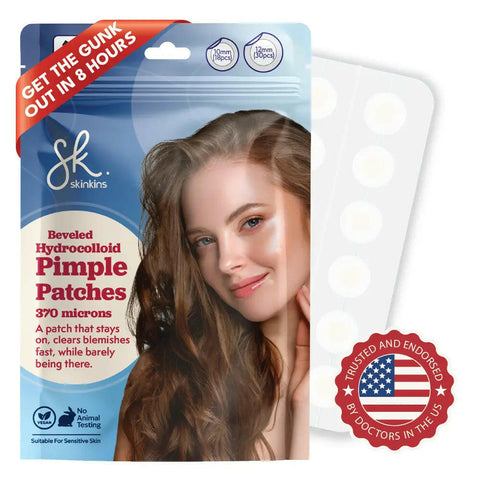
Look Clearer, Faster - Our blemish patches for face work to visibly shrink pimples. A great hydrocolloid patch for faster recovery without irritation.
How the gel matrix works
Hydrocolloids are moisture-retentive dressings made with gel-forming agents such as sodium carboxymethyl cellulose and gelatin. On skin, warmth softens the gummy layer and it starts to absorb fluid and pus to reduce swelling. The fluid reacts with the gel and forms that familiar white bubble, which is a mix of absorbed drainage and gel.
At the same time, the patch creates a moist wound-healing environment that helps the skin's own enzymes work and shields the open spot from bacteria and face-picking. That physical barrier matters because leaving a whitehead alone is what lets it flatten faster, and a patch makes picking physically harder.
When to apply and how long to wear
Patches are most effective once a pimple has come to a head. If there is a visible white or yellow tip, or the spot has just broken, the gel has fluid to draw out. On deep, unheaded cysts or closed blackheads with no open fluid, there is little to absorb and the patch won't drain anything.
Match the patch size to the pimple size so the adhesive seals fully around the edges, not just on top. Apply to clean, completely dry skin and press lightly for a few seconds. Wear time varies by patch and by how much fluid the pimple has to release: leave it on until it turns visibly white and swollen with absorbed fluid, then peel gently along the skin rather than pulling up. If the patch is heavily white before then, replace it with a fresh one rather than squeezing what remains.
SKIN KINS' ultra-thin hydrocolloid patches are built for this kind of wear: thin enough to stay discreet, absorbent enough to show the fluid uptake, and sticky enough to act as a picking deterrent while you sleep.
Hydrocolloid patches work best on pimples that already have a visible white/yellow head — they can't drain a pimple that hasn't formed one yet.
Your Step-by-Step Overnight Pimple Protocol
Less redness and swelling by morning comes down to cleansing gently, applying a single targeted treatment, and protecting the spot while you sleep. The tradeoff is that doing more feels faster, but stacking acids, scrubs, and patches in one night inflames skin and prevents anything from working. Less does more overnight, and here's exactly how to apply it tonight.
- Remove makeup and cleanse. Use lukewarm water and a gentle, non-comedogenic cleanser. No harsh scrubs, no hot water, no over-washing.
- Pat completely dry. Let the skin air-dry for a minute, especially over the blemish. Patches will not stick and spot treatments will slide on damp skin.
- Calm swelling first if needed. If the bump is red and sore, wrap ice in a clean cloth and hold it to the area in short bursts before any topical. Dermatology guides recommend icing in short timed intervals before bed, with breaks in between.
- Apply one treatment only. Either a thin dab of your chosen spot treatment centered on the pimple, or press a hydrocolloid patch onto dry skin, centered without stretching the edges. Do not use benzoyl peroxide and salicylic acid on the same spot at the same time, as this can cause dryness and irritation.
- Moisturize around, not over. Apply a light, non-comedogenic moisturizer to the rest of your face. Keep thick balms and oils away from the active spot so you do not lift the patch or occlude the treatment. If you use benzoyl peroxide, switch to a white pillowcase.
- Protect overnight. Sleep on a clean pillowcase, on your back if you can, and avoid touching or checking the spot.
- Morning touch-up. Splash with cool water, re-ice for a minute if still puffy, then leave the patch on or replace it. If you need coverage, apply non-comedogenic makeup around the patch, not under it. An ultra-thin option like SKIN KINS pimple patches is designed to sit virtually invisible under makeup for this exact step.
What Not to Do: Popping, Toothpaste, and Other Myths
Knowing what to avoid matters as much as knowing what to apply. The American Academy of Dermatology warns that popping pimples yourself risks infection and scarring, and home fixes like toothpaste, lemon juice, and crushed aspirin don't clear pimples overnight. They raise the odds of inflammation, burns, and dark marks instead. Squeezing pushes bacteria and pus deeper, ramps up inflammation, and tears the pore lining, which increases your risk of infection and permanent scarring.
Toothpaste feels drying because it contains detergents, menthol, and baking soda made for enamel, not skin. Dermatologists note it will likely do more harm than good and leave you with a redder, more irritated pimple, with stinging, burning, and lingering redness that is harder to cover than the original bump.
Lemon juice is highly acidic and photosensitizing. Dabbed straight, it can trigger a chemical burn and post-inflammatory hyperpigmentation that lasts weeks after the pimple fades, especially with sun exposure the next day.
Crushed aspirin is not formulated for skin. The particles are abrasive, the dose is uncontrolled, and there is no evidence it shrinks a pimple overnight, only that it can irritate and peel the surrounding barrier.
Picking is also habit-driven: you scan, touch, then squeeze without deciding to. A simple physical barrier that keeps fingers off the spot removes the trigger in the moment and helps break the loop.
| Habit to Check | What It Actually Costs You Tonight | Concrete Example to Stop |
|---|---|---|
| Popping / squeezing | Drives infection deeper, extends healing, risks scar | Squeezed whitehead at 11pm before event on May 3 |
| Toothpaste dab | Redness, stinging, burning, worse inflammation | Used mint toothpaste as spot treatment last night |
| Lemon juice | Acid burn, sun-driven dark marks for weeks | Applied fresh lemon slice at 10pm then morning walk in sun |
| Crushed aspirin paste | Gritty irritation, no proven shrinkage | Mixed aspirin with water, left for 30 minutes |
Some pimples won't respond to any at-home fix in time. Here's when to call in reinforcements.
When At-Home Treatment Won't Cut It: Cystic Pimples and Cortisone
A tender, swollen nodule deep under the skin with no visible head is a cystic pimple, and it won't resolve overnight with at-home treatments. For that lesion, a dermatologist's cortisone shot can dramatically reduce size, swelling, and tenderness within 24-48 hours. For most breakouts, the framework above is enough, but deep cystic pimples are a different problem entirely.
A cortisone shot is not a surface cream. A dermatologist will inject a diluted corticosteroid directly into a cyst, typically a small amount of triamcinolone, which calms the intense inflammatory response inside the lesion. Because cysts and nodules may take weeks to resolve on their own, the injection is used for short-term relief when pain, size, and redness are the immediate concern.
When is it worth booking? If the lesion is large, deeply painful, has no opening for a patch or spot treatment to work, and you have an event in 1-2 days, call. These injections are meant for occasional, targeted use (not as part of a daily routine) and you must wait about 6 weeks between injections in the same spot.
If a pimple is deep, painful, and has no visible head, no overnight topical will fully flatten it — a dermatologist's cortisone injection is the only same-day-effective option.
Tonight, be honest about what you feel: if it's surface-level, match it to the right at-home treatment and expect visible calming, not disappearance; if it's deep and headless, skip the overnight chase and let a professional handle it.
Sources
- How to Get Rid of Pimples Overnight: Dermatologist-Approved Methods | Phoenix Surgical Dermatology
- Benzoyl Peroxide
- www.healthline.com
- How Do Hydrocolloid Bandages Work for Healing Acne & Minor Wounds
- What Are Hydrocolloid Patches for Pimples?
- Pimple popping: Why only a dermatologist should do it
- Why You Should Never Put Toothpaste on a Pimple
- Cortisone Shot in Pasadena, CA | Metropolis Dermatology
- Cortisone Shot for Acne: Benefits & Side Effects
Frequently Asked Questions
Can I use ice and a hydrocolloid patch on the same pimple in one night?
Yes, but do it in order. Ice first to calm swelling and tenderness, then pat completely dry and apply the patch to clean skin so it can seal. Don't ice over the patch, since the moist seal needs direct contact to absorb fluid.
My pimple has no white head yet. Will a hydrocolloid patch still help?
Very little. The patch works by forming a gel that absorbs pus and fluid, and its matrix uses gel-forming agents such as sodium carboxymethyl cellulose and gelatin, so there is nothing to draw out of a closed bump. Save patches for when a head is visible and use ice or a single active to reduce swelling until then.
Is it safe to use benzoyl peroxide and salicylic acid together overnight?
No, not on the same spot at the same time. Dermatology guidance flags that Don't use both benzoyl peroxide and salicylic acid at the same time on the same pimple because it raises dryness, peeling and irritation. Pick one based on pimple type and use only a pea-sized dab.
How long should I leave a hydrocolloid patch on and when should I replace it?
Leave it until the center turns visibly white and puffy with absorbed drainage, which shows it has absorbed fluid and pus to reduce swelling. If it fills earlier in the night, peel gently along the skin and apply a fresh one rather than squeezing.
What strength of benzoyl peroxide should I start with for an overnight spot treatment?
Start low. Benzoyl peroxide comes in 2.5%, 5%, and 10% and lower concentrations still work as a bactericidal agent that releases free-radical oxygen species and oxidizes bacterial proteins. Most people get less redness with 2.5% to 5% for an overnight dab.
When is a cyst painful enough to see a dermatologist for a cortisone shot?
Consider it when you have a deep, tender nodule with no head that won't flatten overnight and stays painful or swollen. A dermatologist can inject a diluted corticosteroid directly into a cyst and swelling often improves within 24-48 hours.
Why is toothpaste a bad overnight fix even though it feels drying?
Toothpaste is made for enamel, not skin. Detergents and menthol can cause redness, stinging and burning, and Cleveland Clinic notes it will likely do more harm than good and leave you with a redder, more irritated pimple.
Can I wear makeup over a pimple patch the next morning?
Yes, if the patch is thin and fully sealed around the edges. Put non-comedogenic makeup around the patch, not under it, so you don't lift the seal or trap product on the open spot. The patch keeps a moist healing environment that protects from infection while you cover surrounding skin.